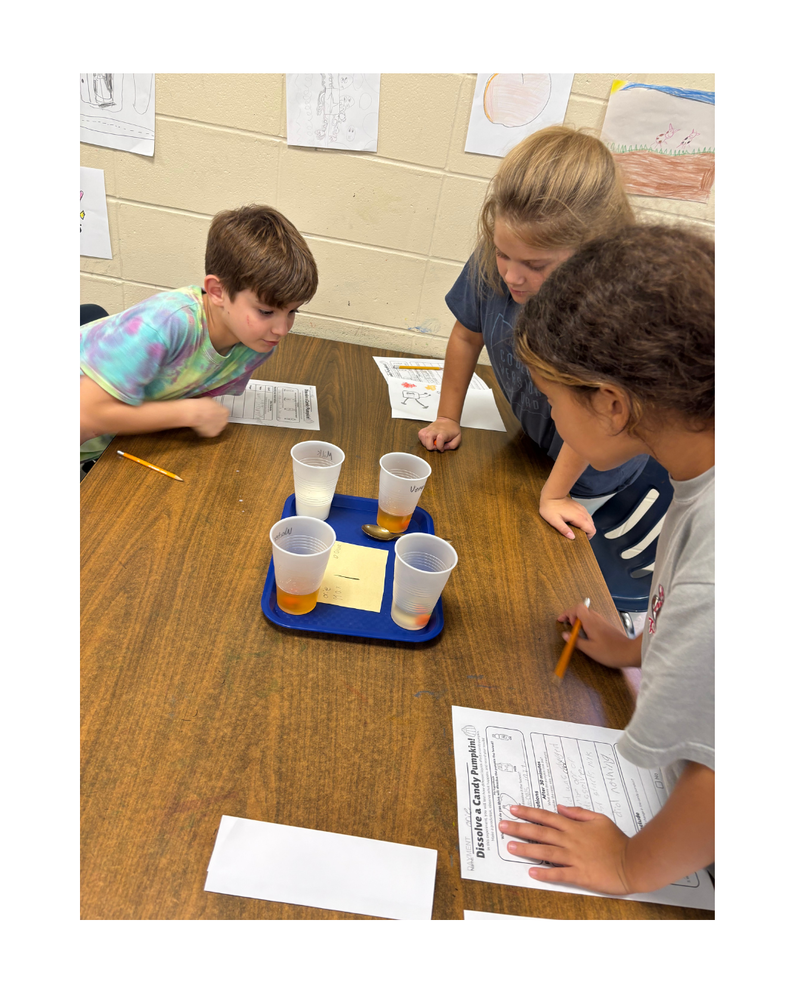
Science took a deliciously fun turn in Mrs. Dayment’s 3rd-grade W.I.N. (What I Need) group as students put on their scientist hats for a hands-on chemistry experiment! Armed with curiosity and a bowl full of festive candy pumpkins, these young researchers set out to discover how different liquids affect everyday candy.
The Experiment
Before dipping a single pumpkin, the 3rd graders put the scientific method into practice. They started by making predictions about what would happen when candy pumpkins were submerged in four common liquids:
Water
Vegetable Oil
Vinegar
Milk
Would the oil make the pumpkin slide around? Would vinegar dissolve the sugar faster? Would milk react differently because of its fats? The classroom was buzzing with hypotheses!
Hands-On Observation
Once the pumpkins hit the liquids, the real scientific work began. Students watched closely, recording visual changes over time and comparing the results across all four tests.
They observed how the sugar coatings began to dissolve, how colors bled into the liquids, and how some liquids barely altered the candy at all. By documenting their findings step-by-step, the group practiced key inquiry skills: precise observation, data recording, and comparing outcomes across controlled variables.
Science Made Sweet
Through this interactive W.I.N. session, Mrs. Dayment’s students proved that science isn't just something you read about in a textbook—it’s something you explore, test, and observe firsthand.
It turns out that learning essential science concepts is always a little bit sweeter when candy is involved! Keep up the great work, young scientists!